Insider Intelligence
From SEC-reported insider transactions to evidence-based investment insights.
MarketWizards Insider brings SEC-reported insider activity into one connected research workflow—from regulatory disclosure to structured transaction data, deeper analysis, and outcome tracking.
Explore Transactions to see what insiders reported in Form 4/4A filings, then use Analysis to investigate qualifying insider purchases through purchase patterns, company context, supporting evidence, and subsequent stock performance.
By connecting the original filing to what happened afterward, the workflow helps evaluate which insider behaviors and purchase patterns have historically been more informative.
Insider Transactions
Explore SEC Form 4/4A activity at the filing level. See who reported the transaction, what was reported, the transaction code and A/D indicator, security, shares, price, and original SEC filing—the regulatory record that starts the MarketWizards Insider workflow.
View TransactionsInsider Analysis
Go beyond the filing record. MarketWizards resolves qualifying insider purchases, builds company-level purchase patterns, adds company, market, and liquidity context, and tracks subsequent stock performance and excess returns—helping identify which patterns have historically been most informative and which activity merits deeper research.
Explore AnalysisFrom disclosure to evidence-based analysis
Start with the filing record
Capture SEC Form 4/4A transaction entries while preserving the original filing, transaction codes, ownership details, securities, shares, and prices.
Resolve and contextualize the activity
Identify genuine qualifying purchases, resolve amendments and ownership relationships, organize activity at the company level, and add company, market, and liquidity context.
Measure patterns and outcomes
Analyze purchase behavior across multiple time horizons and track what happens afterward to determine which measures and patterns have historically been most informative.
Transactions establish the regulatory record. Context turns reported activity into comparable evidence. Analysis measures purchase behavior, tracks subsequent outcomes, and evaluates which patterns have historically been most informative.
Insider transaction data
See What Insiders Are Reporting
Corporate insiders—including officers, directors, and certain beneficial owners—report transactions in their company securities through SEC filings. The Insider Transactions feed organizes those disclosures into a structured, searchable format so investors can review reported activity across issuers.
Use the feed to examine who transacted, what was reported, when the transaction occurred, the type of transaction, the security involved, the number of shares, the reported price, and the original SEC filing.
Explore the Transaction Feed →| Field | What it tells you |
|---|---|
| Issuer and ticker | The company and security associated with the reported transaction. |
| Insider and role | The reporting person and their relationship to the company. |
| Code and A/D | Filed transaction code and acquisition/disposition flag. |
| Date, shares, and price | Transaction date, share count, and reported price. |
| SEC filing | Original SEC Form 4/4A filing for verification. |
From data to context
Not Every Reported Transaction Carries the Same Information
Insiders may sell shares for many reasons, including diversification, taxes, and liquidity needs. A qualifying open-market purchase is different: it represents a direct commitment of capital to the company’s common shares. That makes it a useful starting point for research.
MarketWizards therefore narrows the broader Form 4 universe to qualifying insider purchases—verified purchases of eligible publicly traded common shares that represent a direct personal capital commitment. Option exercises, employee-plan acquisitions, gifts, derivatives, private transactions, duplicate or amended disclosures, sales, and unresolved transactions are excluded.
Qualification is only the beginning. To understand the potential informational value of a purchase, we examine capital committed, insider participation, repeated or accelerating buying, purchase prices against market prices at the relevant time, relative purchase size, liquidity, and short interest. Together, these factors help identify activity worth deeper investigation
How much capital was committed, and how significant was the purchase?
Are multiple insiders buying? Is the activity isolated, repeated, clustered, or accelerating?
How do the purchase price, company size, liquidity, short interest, and recent conditions shape the picture?
Insider analysis
From Context to Evidence-Based Analysis
Context helps us understand a qualifying purchase. Analysis asks whether the pattern has actually been informative. MarketWizards Insider Analysis organizes qualifying purchases into point-in-time research snapshots, measures purchase behavior across multiple time horizons, and tracks what happens to the stock afterward. By connecting the insider's capital commitment with company context and subsequent market performance, the research process helps evaluate which purchase patterns have historically carried the most information.
The objective is not to convert insider buying into a mechanical buy or sell signal. It is to examine whether particular combinations of purchase commitment, insider participation, timing, relative size, price behavior, and company context have historically been associated with more informative outcomes—and to preserve the evidence needed to evaluate those conclusions.
Inside Insider Analysis
See How Qualifying Purchase Activity Becomes Evidence
Each Insider Purchase Pulse brings the filing record, purchase pattern, market context, and subsequent performance together in one point-in-time research view. The examples below show three ways the analysis moves beyond the raw transaction.
Measure the Purchase Pattern
Measure the scale, participation, concentration, and timing of qualifying insider buying across multiple lookback periods, including capital committed, buyers, purchase size, and acceleration.
Track What Happened Afterward
From each Insider Purchase Pulse Date, track subsequent stock performance and compare it with SPY to see how the stock performed after the latest qualifying purchase information became public.
Evaluate What Has Historically Mattered
Bring together purchase behavior, insider cost, market price, company context, and subsequent outcomes to evaluate which measures and patterns have historically been more informative.
Context helps explain the purchase. Analysis connects the pattern with what happened next—and builds the evidence needed to evaluate which characteristics have historically been most informative.
Explore Insider Analysis →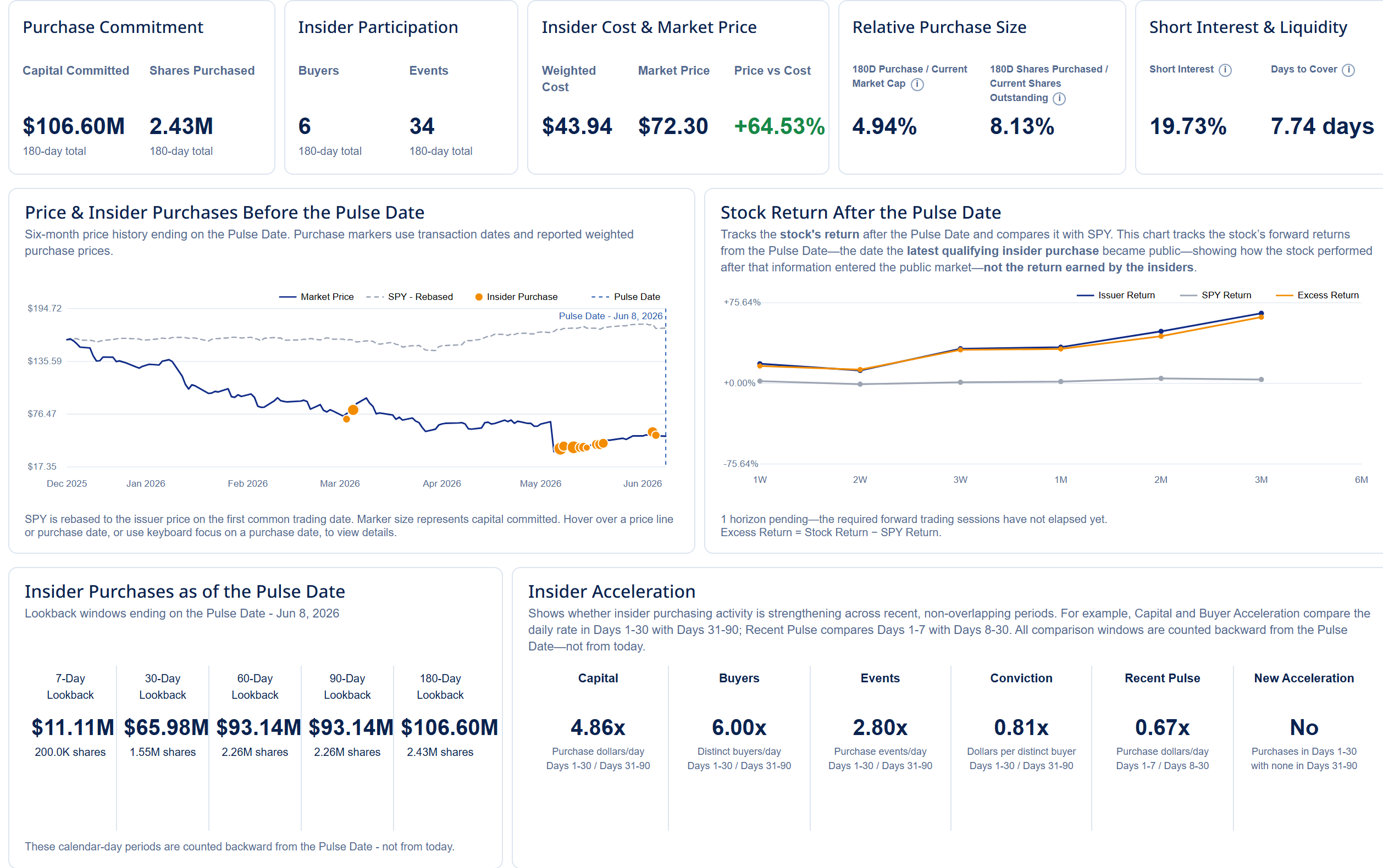
Start With the Data. Go Deeper With the Analysis.
Use the transaction feed to discover reported insider activity, then explore MarketWizards Insider Analysis when qualifying purchases warrant deeper investigation.